


Couldn't load pickup availability
Dynamite Sampler Lite vs Pro Comparison Table
Dynamite Sampler Lite vs Pro Comparison Table
The Pro allows for very sensitive measurements and force derivatives by having an incredibly high dynamic range and low noise.
The Lite is a small and economical variant with a higher noise floor.
Both offer the same BLE connectivity and the same user-friendly app on mobile and web.
| Lite | Pro | |
|---|---|---|
| DISTINCT FEATURES | ||
| RMS Noise with a 100kg Load cell [1] | 16 g | 1 g |
| Dynamic range, with a 350 ohm 2mV/V LC | 76 dB | 100 dB |
| Voltage noise, shorted inputs, 1ksps | 788 nV rms | 67 nV rms |
| Size | 64mm x 41mm x 12 mm | 79mm x 104mm x 24mm |
| Enclosure | Plastic | Aluminum |
| Weight | 20 g | 110 g |
| Load cell excitation voltage | 2.8 V | 4.53 V |
| Max mV/V sensitivity before clipping | 13m V/V | 2.62m V/V |
| GPIO | None | 13 + TX/RX |
| COMMON FEATURES | ||
| Connectivity | BLE (Bluetooth 5.0+ required) | |
| Sampling rate | 1000 Hz | |
| Channels | 4 Channels, simultaneous sampling | |
| Power input | USB-C | |
| Load cell connection | 2-part Screw block terminal, hot-swappable and disconnectable | |
| Calibration | Ratiometric, just values, not temp | |
| Resolution | 24 bits | |
| Software | Identical open source firmware, API, and app | |
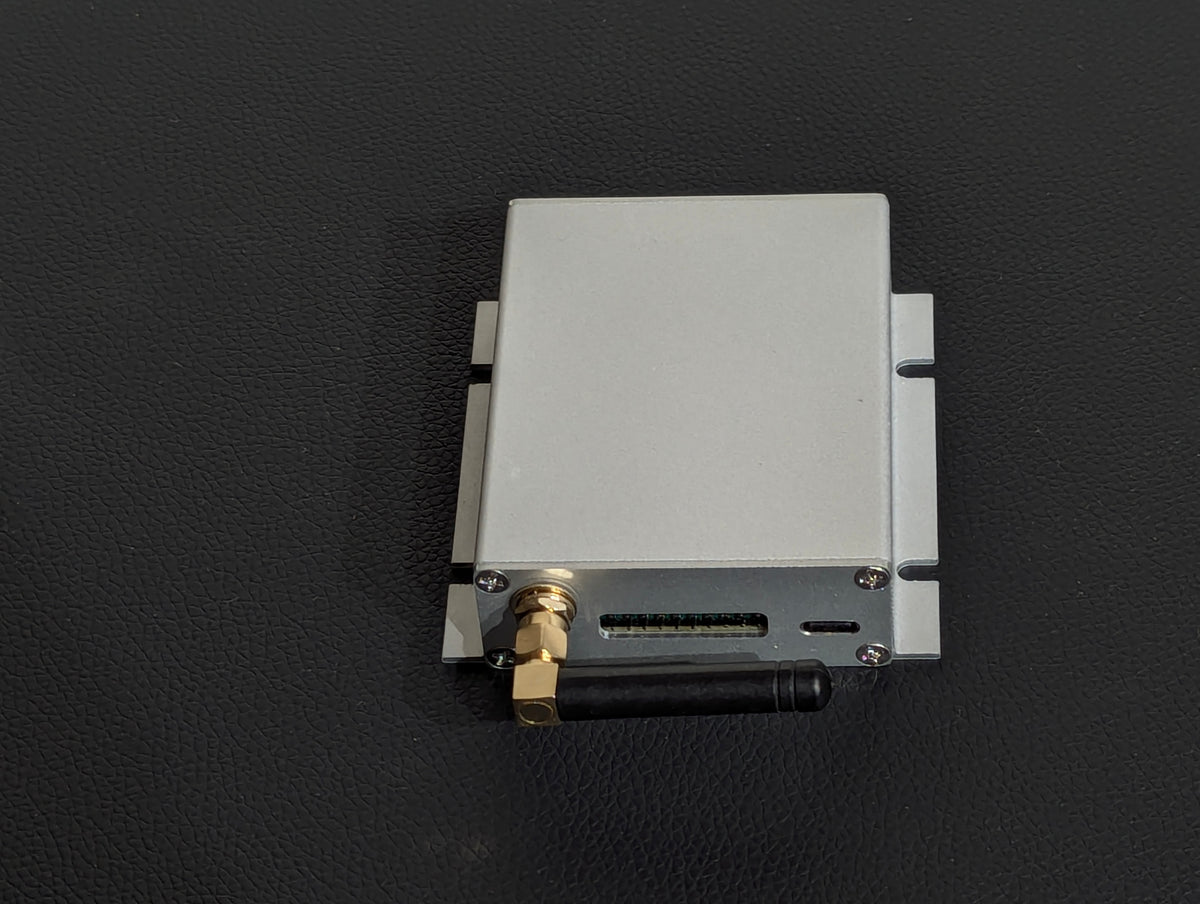
The Dynamite Sampler Pro is a load cell interface with 4-channel, true simultaneous sampling at 1kHz, streamed over BLE.
Extremely low noise floor: 1 gram RMS noise with a 100kg load cell [1]. This is close to the physical limits of what’s possible with an LC. Achieved through our low-noise analog front-end stage. All of this means that you get smooth high-speed derivatives, usable for tasks such as measuring rate of force development.
Extremely tolerant to bad power input. It can withstand 1Vpp noise (0.1Hz-10MHz) and a voltage sag as low as 4V to on the power line with no measurable effect on the signal. Even the cheapest USB adapters with extra-long cables are usable.
Built-in high quality excitation (4.53V).
Open source firmware. https://github.com/K3Engineering/dynamite-sampler-firmware
Open source app. You can test drive it here (no device required) dynamite-app.k3engineering.com
[1] 350 ohm LC, grounded, 1kHz data, no low pass filtering, not equalized.
| Feature | Specification | Notes |
|---|---|---|
| Physical characteristics | ||
| Size | 79mm x 104mm x 24mm | |
| Enclosure | Aluminum | |
| Weight | 110g | |
| Load cell connection | 4-wire screw block terminal, 2-part disconnectable | |
| Mounting bolts | M4 | |
| Mount point measurements | 45mm x 69mm | |
| Electrical characteristics | ||
| Signal input range, mV | ±11.88 mV | High-sensitivity load cells will clip at high loads, but the device will not be damaged. |
| Signal input range, mV/V | 2.62mV/V | High-sensitivity load cells will clip at high loads, but the device will not be damaged. |
| Gain | 101x | |
| Load cell excitation voltage | 4.53V | |
| Max EXC+ current | 200mA | Shared across all 4 channels. |
| Voltage noise, shorted inputs, 1ksps | 67nV rms | In practice, load cell thermal noise is a significant noise contributor. Current noise is not a significant contributor. |
| Dynamic range, with a 350-ohm 2mV/V LC | 100dB | Calculated as 20·log₁₀(V_FS / V_noise,rms). |
| PSRR, 10Hz to 10MHz | >130dB | Below noise floor with 1Vpp aggressor signal. |
| CMRR, 10Hz to 10MHz | >130dB | Below noise floor with 1Vpp aggressor signal. |
| Allan plot valley | 8nV at 2 seconds | |
| Calibration | Yes | 5-point ratiometric (LC simulator, mV/V), at a single logged temperature. |
| Temperature sensor | Yes | TMP118 |
| Temperature stability | TBD; typically below the noise floor during operation including warm-up. Guaranteed <1µV/°C. | |
| GPIO | 13 + TX/RX | |
| EMI filtering | Advanced multi-stage | Can withstand interference from a phone and a walkie-talkie as close as 1" away from the device. |
| ESD | All pins, including input | |
| Power consumption, streaming, no LCs attached | 77mA avg at 5V | |
| Accuracy | ±0.2% (factory calibrated, calibration auto-applied) | Device streams raw data; calibration is stored in flash and sent over before streaming. |
| Microphonics (motion converted into signal) | No measurable effect on signal in coarse testing | There is some additional gasket damping of the PCB inside the case. |
| Min input voltage | 4V | |
| Digital characteristics | ||
| Connectivity | BLE (Bluetooth 5.0+ required) | |
| Sampling rate | 1000 Hz | Raw ADC values, no filtering or EQ. ADC uses sinc3+sinc1 decimation internally. Analog AA does not impact 1ksps sampling speed. |
| Channels | 4 channels, simultaneous sampling | |
| Power input | USB-C | |
| Resolution | 24-bit | |
| ADC decimation filter's -3dB point at 1ksps (calculated) | 448 Hz | Note that the hardware AA filter's -3dB point is at 8kHz. |
| Software | ||
| GUI compatibility | Chrome and Bluefy only for the web app; native Android and iOS apps available. | |
| GUI Functionality | Live plotting, gap detection, derivative plotting, recording, exporting to CSV, OTA updates. | |
| API | Python | |
| Software availability | Open Source Software (OSS): app, Python API, and firmware. | |
| Firmware updates | Through the app; saved data is preserved. | |
Application notes
In our experience, the metal body of the load cell body is electrically insulated from any of the leads in the cable. Notably, on anodized aluminum load cells, the only area that is conductive to the LC body is the threads. This means that if the LC mounting is nonconductive (or the mounting jig itself is not grounded), the LC body is floating regardless of the connection to the LC interface or what the LC interface does.
In case of a floating LC body, the primary form of mains coupling is H-field. In regular use, this mains coupling is detectable via FFT but doesn’t meaningfully affect RMS noise numbers. However, in very close proximity (below 6”) to mains, without mitigation, it can result in very significant signal presence. Given that H-field coupling isn't a traditional grounding loop, galvanic isolation does not help. To mitigate, make sure that the LC body is grounded, either through the jig, or by connecting it to the GND lead. In the Pro model, if planing to use the aluminum case as a grounding point, note that the case itself is anodized.
Given the electrical insulation between the LC bridge and the LC body, ground loops are typically not an issue. However, if they do become an issue, please send us an email so we are aware of the use case. We have tested our interface in the following isolation configurations: 1) powering off a battery (power bank or phone) 2) using a galvanic isolator such as a standard $20 B0505s-1W + ADUM3160 + X USB isolator, or powering off of galvanically-isolated PoE (GPD2CAT-20V in our testing). If you find that your load cell body has conductivity to the leads, we'd love to hear about that as well.
We have also tested our interface in situations such as powering off of a PC USB hub - in which case the signal is typically within the noise spec without any mitigations (floating LC body).
In practice, we see about a 3C rise during the 30-minute warm-up period.


Load cell Interfaces
-
 Sold out
Dynamite Sampler Pro
Regular price $625.00 CADRegular price -
 Sold out
Dynamite Sampler Lite
Regular price $208.00 CADRegular price

